Complete Manual Testing

Live Online Training

Complete Manual Testing

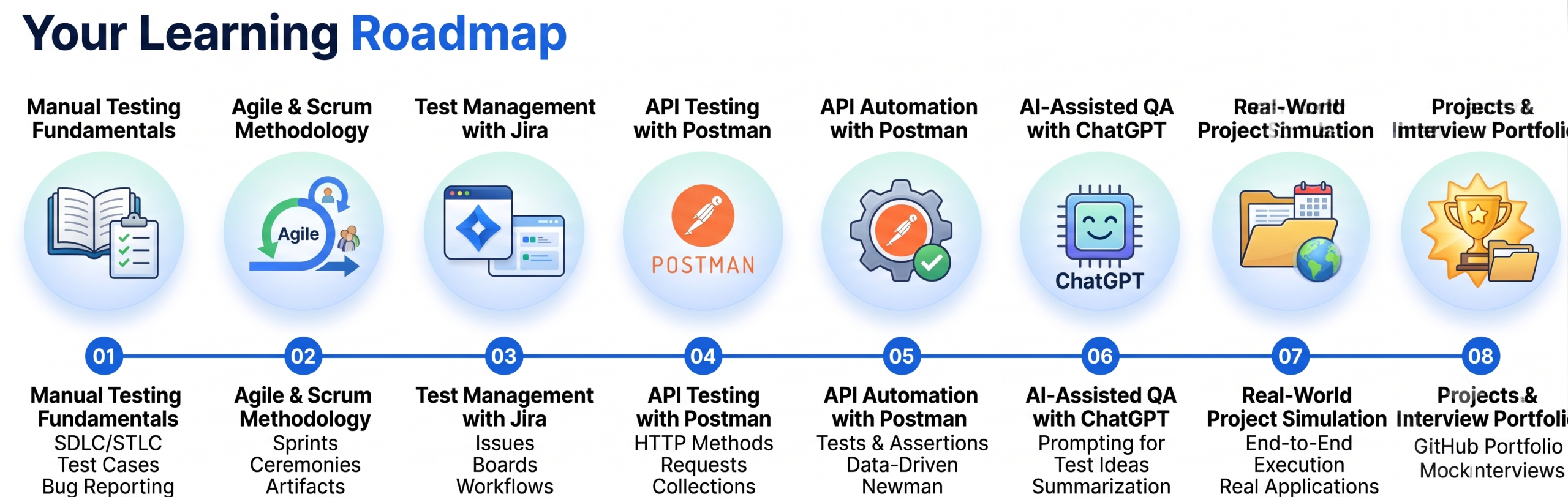
Manual Testing + Agile + API Postman + AI Testing + Jira + Projects

A complete Manual Test engineer program designed to take you from zero to job-ready with live projects, Including AI with Chatgpt and Many Latest Tools 

Why Join This Program?

Live Zoom Classes
Interactive live sessions

Placement Guidance
Job guidance and career sessions

Certificate 
Get a Course completion certificate

Preparation
Reviewing Resume, mock interviews

Lifetime Access
Lifetime accessto recordings 

Notes & Resources
Well-structured notes,& eBooks.

UpComing Live Batch

Start Date

28 Sep 2026

Time

8 PM IST

Duration

30 Days [Apx]

Type

Weekdays

Note : First Two Session are Free / Orintation Session


₹ 10000  30% OFF

₹ 6999

🔥 Save ₹3,000

🎯 Limited Time Offer
⭐⭐⭐⭐⭐ 4.8/5 Rating
10,000+ Students

Who Should Join?

  • Feshers who want to start a career in QA
  • Manual Testers who want to switch to Automation
  • Developers or Professionals looking to switch to QA
  • who wants to build a strong career in Software TestingF
ChatGPT Image Jul 27, 2026, 05_51_00 PM4

Meet Your Trainer

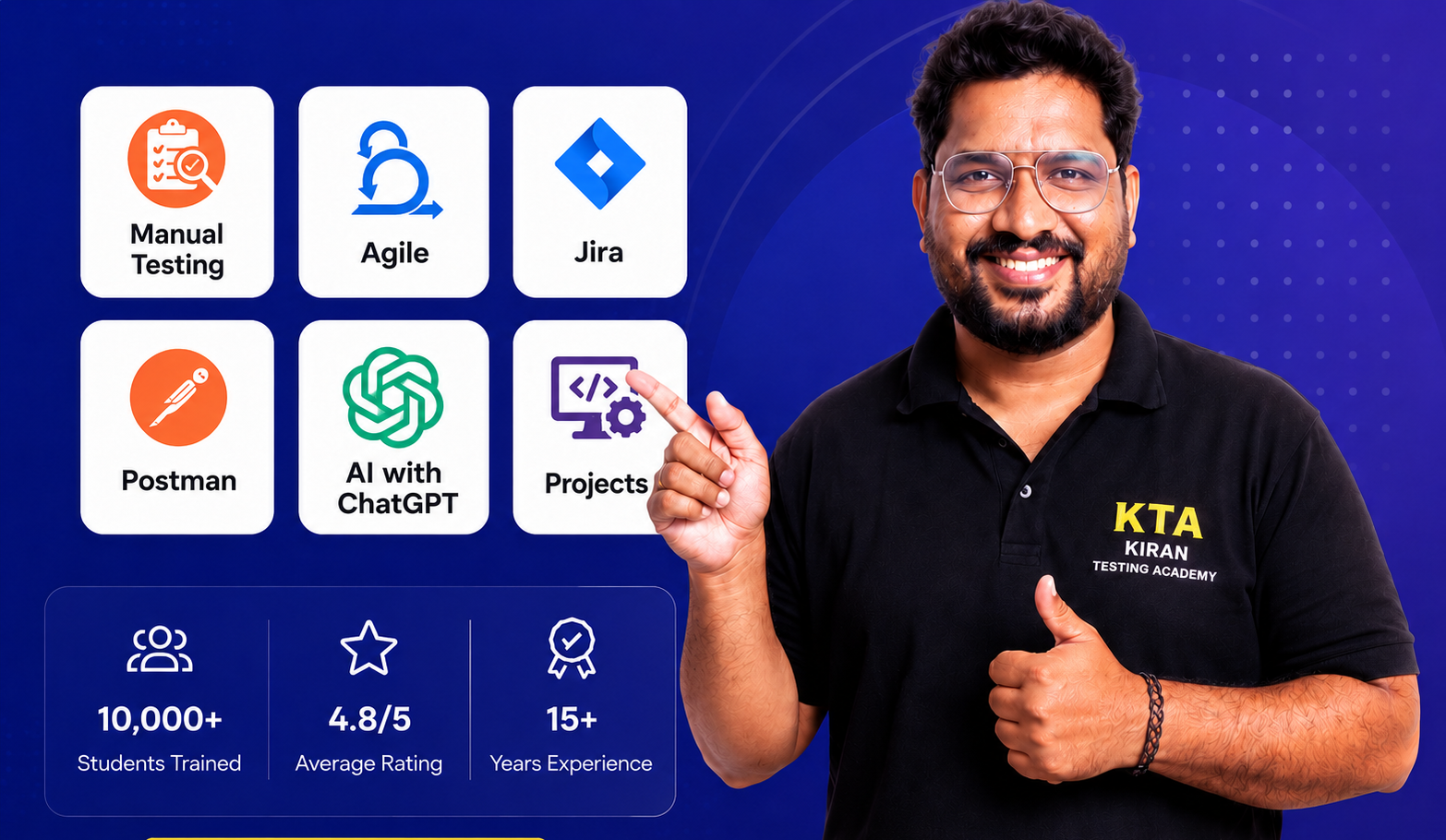
Kiran Kumar
Software Test Architect
✅ 15+ Years of Industry Experience
✅ Trained 10,000+ Students
✅ YouTube Channel with 25K+ Subscribers
✅ Expert in Manual & Automation Testing
✅ Passionate about Teaching & Mentoring
✅ Premium Instructor on Udemy 

Course Curriculum (Modules)

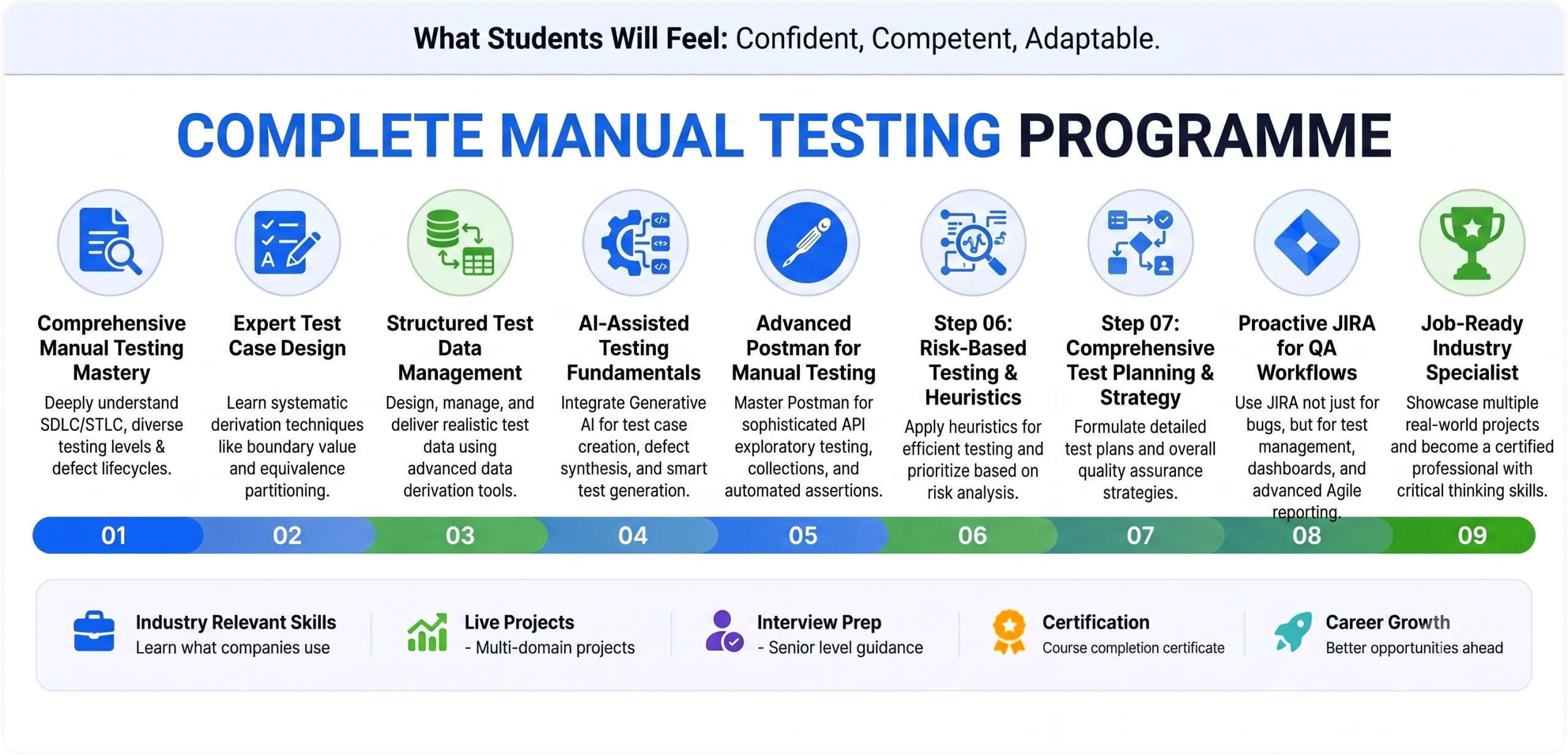
Module 1 : Introduction To Software Testing (Manual Testing)

Course Curriculum: Modern Software Testing & Quality Assurance

Module 1: Foundations of Quality Engineering

  • What is software testing: Principles, myths, and economics of QA

  • Static vs. Dynamic testing; Verification vs. Validation

  • SDLC models: Waterfall, V-Model, and Agile overview

  • Deep dive into STLC phases: Planning, Analysis, Design, Environment Setup, Execution, and Closure

  • Designing a Test Strategy and Test Plan document

Module 3: Testing Levels & Functional/Non-Functional Types

  • Levels: Unit, Integration, System, and User Acceptance Testing (UAT)

  • Functional Testing: Smoke, Sanity, Regression, and Retesting

  • Non-Functional Testing: Basics of Performance, Usability, Accessibility, and Security

Module 4: Practical Test Design Techniques

  • Black-box techniques: Equivalence Class Partitioning, Boundary Value Analysis

  • Logic-based testing: Decision Tables, and Use Case testing

  • Writing professional test cases, scenarios, and requirement traceability matrices (RTM)

Module 5: Defect Tracking & Bug Lifecycle

  • Anatomy of an effective bug report (Severity vs. Priority, reproducibility steps, logs)

  • Bug lifecycle transitions and triage meetings

  • Hands-on defect logging and tracking using Jira

Module 6: Agile QA & Shift-Left Practices

  • Scrum ceremonies: Sprint Planning, Daily Stand-ups, Sprint Review, and Retrospectives

  • User stories, Acceptance Criteria, and “Definition of Done” (DoD)

  • Exploratory testing and Session-Based Test Management (SBTM)

Module 7: AI-Augmented Manual Testing

  • Prompt engineering for QA: Generating test scenarios and synthetic mock data

  • Using LLMs for requirement ambiguity analysis and edge-case discovery

  • AI tools for visual UI validation and automated defect summarization

Postman API Testing for Beginners (Manual Testing Only)

Section 1: Introduction to APIs

  1. Course Introduction

  2. What is an API?

  3. What is API Testing?

  4. Types of APIs

  5. API vs Web Application Testing

  6. Real-world API Examples

  7. Understanding Client-Server Architecture


Section 2: HTTP Basics

  1. What is HTTP?

  2. HTTP Request & Response

  3. URL Structure

  4. HTTP Methods (GET, POST, PUT, PATCH, DELETE)

  5. HTTP Status Codes

  6. Request Headers

  7. Response Headers


Section 3: Installing & Exploring Postman

  1. Install Postman

  2. Create a Free Account

  3. Postman Interface Overview

  4. Creating Your First Request

  5. Understanding Request Builder

  6. Saving Requests


Section 4: Working with GET Requests

  1. Creating GET Requests

  2. Query Parameters

  3. Path Parameters

  4. Viewing Response

  5. Pretty, Raw & Preview Views

  6. Response Time & Size


Section 5: Working with POST Requests

  1. Creating Resources

  2. Request Body

  3. JSON Basics

  4. Raw vs Form Data

  5. Sending JSON Data

  6. Verifying Response


Section 6: PUT, PATCH & DELETE

  1. Updating Data Using PUT

  2. Partial Updates Using PATCH

  3. Deleting Records

  4. Verifying CRUD Operations


Section 7: Understanding JSON

  1. What is JSON?

  2. JSON Objects

  3. JSON Arrays

  4. Nested JSON

  5. Reading API Responses

  6. JSON Formatting Tips


Section 8: Variables & Environments

  1. Why Variables?

  2. Global Variables

  3. Collection Variables

  4. Environment Variables

  5. Switching Environments


Section 10: Authentication Basics

  1. Why Authentication?

  2. Basic Authentication

  3. Bearer Token Authentication

  4. API Key Authentication


Section 11: Manual API Validation

  1. Verifying Status Codes

  2. Validating Response Body

  3. Validating Headers

  4. Checking Response Time

  5. Negative Testing

  6. Error Responses

 Inside This Course